projects/refinery
Refinery — drag-and-drop serverless IDE
Co-founded and led engineering on a YC-backed visual IDE that let developers assemble code "blocks" like Lego and one-click-deploy them to AWS Lambda — the company that later pivoted into LunaSec.
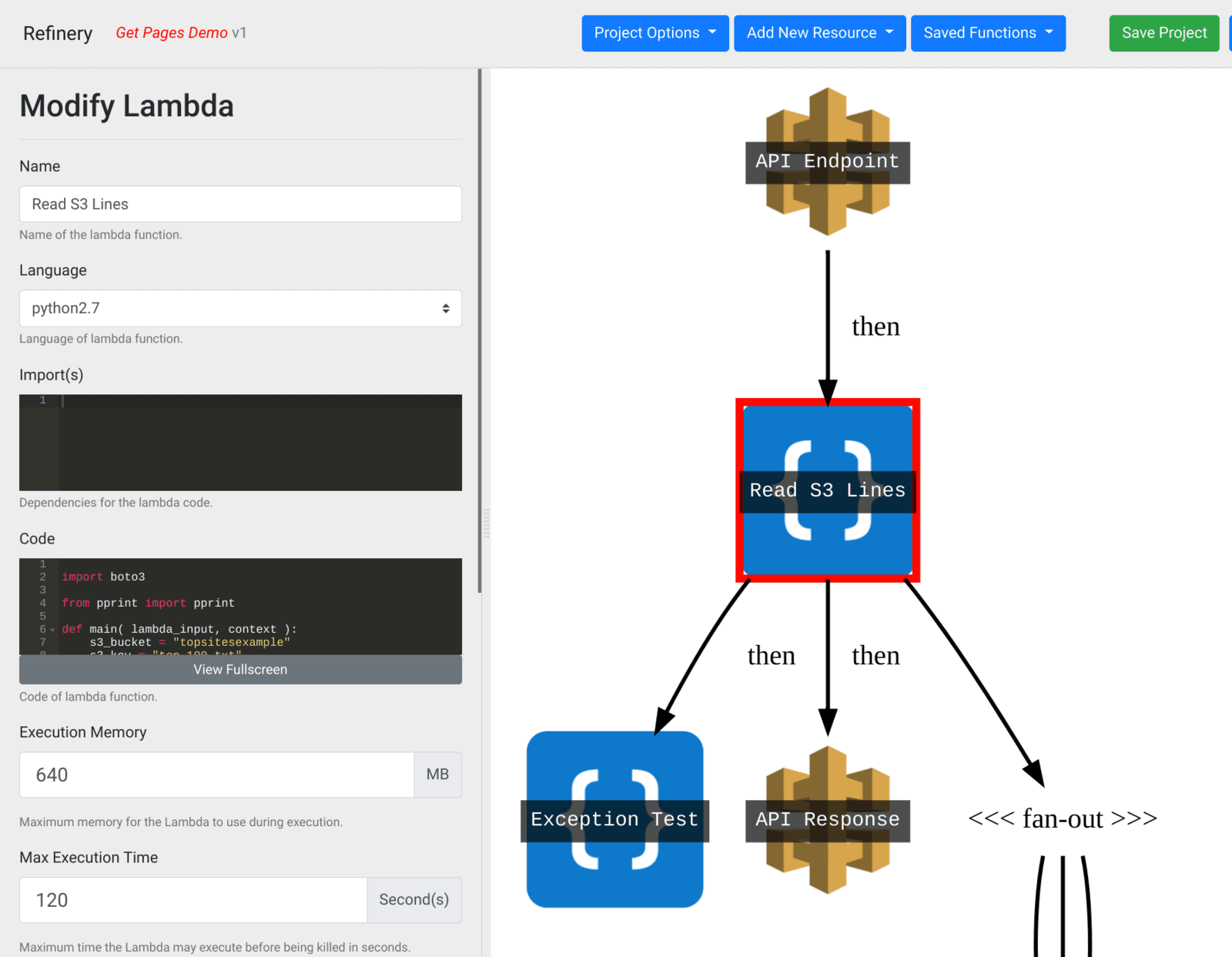
Refinery Labs was a Y Combinator-backed startup where I was a co-founder and CTO. The product billed itself as the world’s first drag-and-drop serverless IDE: a web-based canvas where you snap together blocks of code — Lego-style — and wire them to cloud services, then deploy the whole pipeline to AWS Lambda in one click. The pitch was to collapse the gap between “I have an idea for a small cloud service” and “it is running in production,” which at the time meant hand-writing IAM policies, deployment configs, and glue between managed services.
Under the visual editor, blocks compiled down to real Lambda functions with the surrounding plumbing — API Gateway endpoints, Simple Queue Service topics, and other AWS primitives — generated and connected automatically. Refinery shipped as a self-hostable platform: you cloned the repo, ran an AWS-account configuration script, and stood the whole IDE up against your own account with docker-compose, under an Apache-2.0 license. The open-sourced codebase covers the full platform — editor, API, and deployment engine — rather than a thin front end.
The editor itself was a deliberate engineering-culture decision. I chose Vue.js and Vuex over React and Redux for the front end specifically because it was faster for a small team to become productive in — several engineers didn’t already know React, and Vuex’s state model was easier to onboard onto than Redux. Picking the framework that maximizes a young team’s velocity, rather than the most fashionable one, is the kind of trade-off that matters more at a four-person company than the merits of any given library.
Refinery was the earlier incarnation of the company that later pivoted into LunaSec, carrying the same founding team and Heroku-for-serverless instincts into security tooling. The serverless IDE is no longer actively developed, but its code remains public.